.png?resize=600x0)
From Launch Pads to Possibilities: What Artemis II Teaches Us About Careers in Supply Chain

When we watch a spacecraft launch, most people see astronauts. Few see the supply chain.
As I reflect on my recent participation on the panel at the Southern Alberta Institute of Technology (SAIT), SAIT Supply Chain Management Club Industry Night, one theme stood out clearly: Students and professionals are looking for direction, certainty, and opportunity in an increasingly complex world.
At the same time, many of us were watching history unfold with the Artemis II mission.
With Canadian astronaut Jeremy Hansen alongside Reid Wiseman, Victor Glover, and Christina K., global attention was rightly focused on the crew. But what struck me most was not just who was onboard, but who was behind it.
The Reality Behind the Mission
Artemis II is not NASA - National Aeronautics and Space Administration alone.
It is the result of a deeply integrated, global supply chain:
NASA lead mission architecture
European Space Agency - ESA delivering the service module with contributions from Germany, Italy, France, Belgium, Switzerland, Spain, Denmark, Norway, the Netherlands, and Sweden
Canadian Space Agency | Agence spatiale canadienne contributing critical systems and expertise.
And that is only the beginning.
Core contributors include:
- Boeing
- Northrop Grumman
- Aerojet Rocketdyne
- United Launch Alliance (ULA)
- Lockheed Martin
- Airbus Defence and Space
- Thales
- Jacobs
- Bechtel Corporation
- The Aerospace Corporation

Beyond that are layers of sub-tier and specialized contributors:
- Constellium
- Honeywell Aerospace Technologies
- Moog Space and Defense
- McDanel Advanced Materials
- Telespazio
And even further still, an expansive network supporting:
Chemicals and propellants: Airgas, Praxair, Inc - a Linde Company, Arkema
Electronics and systems: Renesas Electronics, Teledyne Technologies Incorporated
Engineering and infrastructure: Amentum, RS&H, Bechtel Corporation
Materials and protection systems: Albany International Corp., W. L. Gore & Associates
This ecosystem is not linear. It is multi-layered, global, and interdependent.
Where Supply Chain Becomes Opportunity
The students attending the Industry night asked Laine Knutson, Greg Tocheniuk, Emmanuel Fongeh MSc,PMP,PSM,SSM, Allan To, and me an important question:
- Where do I fit?
The answer is broader than most expect.
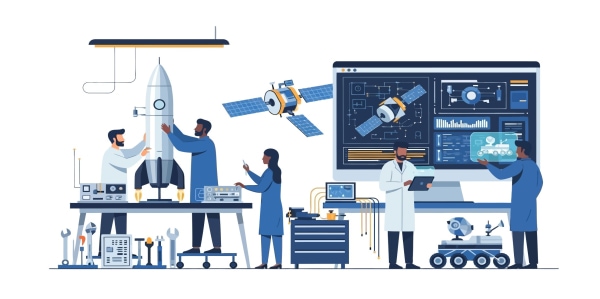
Consider the disciplines required to support a mission like Artemis II:
- Advanced manufacturing and precision machining
- Additive manufacturing and friction stir welding
- Cryogenic propellants and solid energetics
- Thermal protection systems
- Radiation-hardened semiconductors
- Systems integration and software engineering
- Telecommunications
- Environmental control systems
- Aerospace medicine and food science
- Civil engineering and construction
- Heavy transport and maritime recovery
- Insurance and risk management
- International law and governance
This is the supply chain.
A Shift in Perspective
Many individuals begin with a basic idea:
“I want to work for NASA.” “I want to be an astronaut.”
But the more impactful question is:
What part of the whole ecosystem can I contribute to?
Because every role matters.
Every material sourced. Every component is engineered. Every system tested. Every shipment delivered.
Each one is critical to the outcome.
What This Means for the Next Generation
To the students and early career professionals navigating uncertainty:
There are NO limits to where a career in supply chain can take you.
The constraints we feel are often self-imposed rather than structural.
Careers are not built in a straight line. They are built through:
- exploration
- skill development
- adaptation
- and contribution
The same way Artemis II was built.
Final Thought
When you look at a spacecraft on a launch pad or orbiting the Earth, do not just see the destination.
See the ecosystem behind it.
Because within that ecosystem lies one of the most expansive, resilient, and opportunity-rich career landscapes available today.
And there is a place within it for those willing to explore where they can contribute.